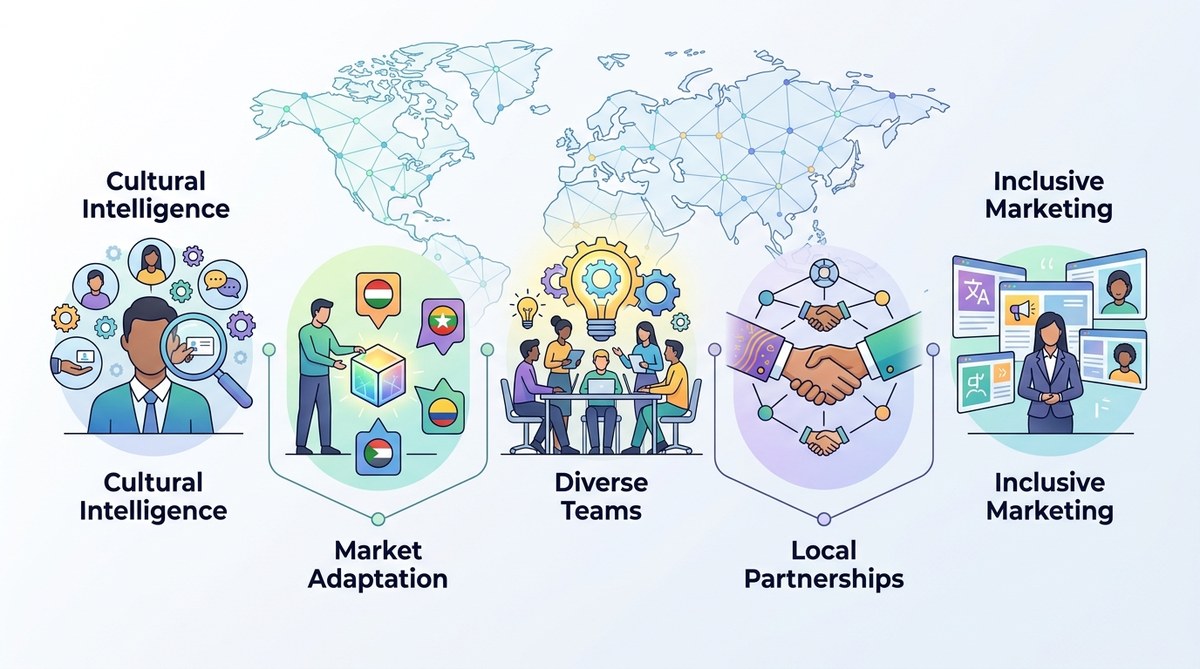
As you expand your business across borders, you will notice that people in different markets think, communicate, and make decisions in ways that can feel foreign. Most entrepreneurs see this as a challenge. They try to smooth over differences or impose their own culture on new markets. That approach costs you trust and money. The truth is that cultural differences are not roadblocks. They are raw materials for a stronger, more resilient business. When you learn to turn those differences into a competitive advantage, you build something that no single-culture competitor can easily copy.
Cultural diversity is a strategic asset, not a hurdle. Global entrepreneurs who adapt communication styles, blend team perspectives, localize products with respect, and build trust through authentic cultural understanding outperform rivals. This guide gives you five proven ways to turn cultural differences into a lasting competitive edge for your international business in 2026.
Why your cultural blind spot costs you market share
Think about the last time you entered a new country with your product. Did you assume that what worked in the United States would work in Japan or Brazil? Many founders do. They miss local etiquette, communication norms, and decision making hierarchies. The result? Low adoption rates, frustrated teams, and missed revenue.
The opposite approach is powerful. By actively learning and leveraging cultural differences, you gain insights that competitors who stay inside their own bubble never see. You build deeper relationships with local partners, create products that truly fit the market, and attract top global talent.
A 2026 study by McKinsey found that companies with culturally diverse leadership teams are 36% more likely to outperform their peers on profitability. That is not a coincidence. Diversity in thinking leads to more creative problem solving and better risk management.
Five ways to turn cultural differences into a competitive advantage
These strategies come from the core principles outlined on the pillar page at the Global Entrepreneur Summit. Each one turns a potential friction point into a strength.
1. Adapt your communication style, not just your language
Many entrepreneurs think translation is enough. They hire a local translator and call it done. But culture shapes how people interpret words, silence, and body language. In high context cultures like Japan or Saudi Arabia, much of the meaning comes from unspoken cues, status, and relationships. In low context cultures like Germany or Australia, people value direct, explicit messages.
If you speak directly to a Japanese partner without building rapport first, you seem rude. If you are too indirect with a German client, you seem unreliable.
The fix is to train your team in cultural communication frameworks. Start by identifying whether your target market is high or low context. Then adjust your emails, meetings, and negotiations accordingly. This seems simple, but few companies do it well. The ones that do win loyalty and faster deal cycles.
2. Use diverse teams to spot blind spots
When your entire leadership team shares the same cultural background, you all miss the same opportunities. Homogeneous groups fall into groupthink. They design products for themselves, not for the global customer.
Build a team that reflects your target markets. Include people from different regions, educational systems, and socioeconomic backgrounds. Encourage them to challenge assumptions. For example, an Indian team member might point out that your subscription pricing model does not work in a market where people prefer pay as you go. A Brazilian colleague might note that your marketing campaign uses colors that have negative associations in Latin America.
This is not just about avoiding mistakes. It is about discovering new product features, marketing angles, and business models that you would never find on your own. For more on assembling such teams, read how to build a global team that drives innovation across borders.
3. Localize with respect, not with a template
Localization goes deeper than changing currency symbols and date formats. It means understanding the values, taboos, and daily realities of your customers. A one size fits all approach fails everywhere.
Consider McDonald’s. They serve a McSpicy Paneer Wrap in India, a McArabia in the Middle East, and a McRib in the United States. They do not simply rename the same burger. They adjust recipes, portion sizes, and even restaurant layouts to fit local habits.
As a global entrepreneur in 2026, you do not have McDonald’s resources. But you can still apply the same principle. Spend time in the market. Hire local cultural advisors. Run small tests before scaling. Respect local sensibilities in everything from product packaging to customer service scripts.
4. Build trust across different relationship systems
In some cultures, business relationships start with a handshake and a contract. In others, you need to share meals, exchange gifts, and learn about the other person’s family before discussing terms. If you rush the trust building phase, you lose the deal.
Create a relationship map for each market you enter. Ask locals: how do people build trust here? Who are the key influencers? How long does a typical negotiation take? Then allocate time and budget accordingly.
This is especially important in markets like China and the Middle East, where guanxi and wasta (personal connections) drive business. If you ignore these systems, you are not seen as a serious partner. But if you invest in them, you gain access to networks that your competitors cannot replicate.
5. Turn cultural friction into product innovation
Sometimes the biggest opportunities come from the biggest frustrations. When you notice a cultural clash that slows down your operations, ask: can we build a solution for this?
For example, a global logistics startup might realize that different countries have different norms around delivery confirmation. In one market, people expect a signature. In another, a photo of the package at the door is enough. Instead of treating this as a headache, the startup builds a flexible platform that adapts to each country’s preferred confirmation method. That becomes a unique selling point.
Cultural friction reveals unmet needs. Pay attention to them. They are free market research.
| Strategy | Common Mistake | Better Approach |
|---|---|---|
| Adapt communication | Assume English is enough everywhere | Learn and mirror local communication style (high vs low context) |
| Diverse teams | Hire for cultural fit instead of cultural complement | Intentionally recruit people who challenge the dominant culture |
| Localize with respect | Use translation software without review | Work with local cultural consultants and run user tests |
| Build trust | Rush to close deals in relationship based cultures | Invest time in personal connections and local intermediaries |
| Product innovation | See differences as obstacles | Treat each friction point as a prompt for a new feature or service |
The three steps to start turning culture into advantage today
You do not have to wait for a major international expansion. Start with these three actions this week.
-
Audit your current team’s cultural diversity. Write down the nationalities, languages, and backgrounds of your top 10 team members. Where are the gaps? Where are the overrepresented groups? Pick one underrepresented market you want to enter and hire a part time cultural advisor from that region.
-
Map your top target market’s communication style. Use online resources or ask someone who lives there. Is it a high context or low context culture? What is the preferred negotiation pace? Write a one page guide for your sales team.
-
Identify one cultural friction point in your current operations. Maybe a customer support interaction went wrong because of a misunderstanding about politeness. Document it. Brainstorm a product or process change that turns that friction into a feature.
For a broader view of where global opportunities are emerging, check out how emerging markets are fueling the next wave of global entrepreneurs. It will help you prioritize which cultural differences to focus on first.
“The biggest competitive advantage in global business is not technology or capital. It is the ability to see the world through other people’s eyes. Cultural empathy opens doors that spreadsheets cannot.” – Dr. Lina Chou, cross cultural strategy professor at INSEAD
What global entrepreneurs get wrong about cultural differences
Some common myths can sabotage your efforts. Here is what to watch out for:
- Myth: My product is so good that culture does not matter. Reality: Even great products fail if they ignore local norms. Remember when Walmart tried to enter Germany with American style service and no price matching culture? It lost billions.
- Myth: Cultural training is a one time workshop. Reality: Culture changes over time and varies by region within a country. You need ongoing learning.
- Myth: Only big companies need to worry about this. Reality: Small startups can adapt faster. Use it as your speed advantage.
- Myth: English proficiency means cultural alignment. Reality: A fluent English speaker from India or Nigeria may have very different business values than someone from Texas.
How to measure your cultural competitive advantage
You should track progress over time. Here are some metrics that matter:
- Revenue growth per market compared to industry benchmarks
- Employee retention among local hires in each region
- Time to close deals in new markets (should decrease as you get better at cross cultural communication)
- Number of product adaptations that originated from local team feedback
- Customer satisfaction scores segmented by country
If you see improvements in these areas, you are on the right track. For more insights on building leadership skills that work across cultures, read building leadership skills for global entrepreneurs to scale their businesses.
Your next move in 2026
Cultural differences are not something to fear or stamp out. They are your single best source of sustainable differentiation. While competitors fight on price and features that everyone can copy, you can build deep relationships, intuitive products, and agile teams that only cultural fluency enables.
The world is not flattening. It is getting more diverse and more connected at the same time. Entrepreneurs who embrace that paradox will lead the next wave of global business. Start small. Pick one market, one cultural insight, and one action today. Your future competitive advantage depends on it.

Leave a Reply