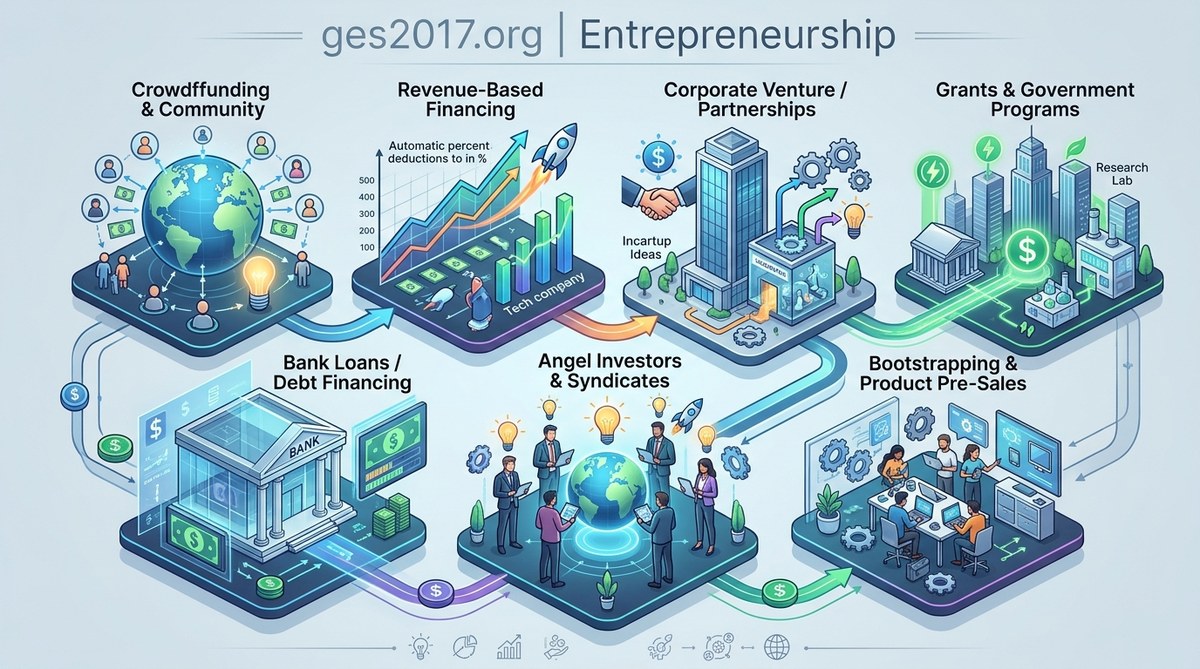
The traditional path of pitching a dozen VCs, giving up 20% of your company, and hoping for a term sheet is no longer the only game in town. In 2026, global entrepreneurs are building real businesses using funding models that let them keep control, move faster, and match their revenue reality. Whether you are bootstrapping in Austin, building in Nairobi, or scaling in Singapore, the options beyond venture capital have matured into legitimate, scalable alternatives. This guide breaks down seven of them.
Venture capital is not the only path to growth. In 2026, founders are using revenue based financing, government grants, crowdfunding, DAO treasuries, and strategic partnerships to fund their startups without giving up equity or control. Each model fits a different stage, risk profile, and business type. Matching your model to your revenue model is the real secret.
Revenue Based Financing: Growth Without Dilution
Revenue based financing (RBF) lets you trade a percentage of future revenue for upfront capital. You pay back a fixed multiple, usually between 1.1x and 1.5x, and the payments rise and fall with your sales. No fixed monthly installments. No personal guarantee in many cases.
This model works best for startups with recurring revenue. SaaS companies, subscription boxes, and marketplaces that process payments are ideal candidates. RBF providers look at your monthly recurring revenue and churn rate, not your pitch deck.
“RBF aligns incentives perfectly. The lender only makes money when you do. That changes the whole conversation.” – Sarah Chen, founder of a B2B SaaS startup that used RBF to fund its Series A growth.
A few things to watch for:
– The cost of capital can be higher than a traditional bank loan if you grow very fast.
– Some RBF contracts include personal guarantees or blanket liens.
– You need at least $5k to $10k in monthly recurring revenue to qualify.
Government Grants and Innovation Incentives
Governments around the world are handing out cash to startups. In 2026, the total pool of non-dilutive grants for early stage companies exceeds $50 billion globally. The catch is that most founders never apply.
Grants are not just for deep tech or biotech anymore. You can find grants for:
– Climate tech and sustainability
– AI and machine learning applications
– Rural and underserved community development
– Export and international expansion
The application process takes time, but the payoff is pure capital with zero equity loss. Many grants also come with mentorship, lab access, or pilot partners. For a step by step look at how to find and win these opportunities, check out this guide on innovative strategies for securing international funding in 2026.
Crowdfunding: More Than Just Pre Orders
Crowdfunding has evolved past the Kickstarter stereotype. In 2026, founders use it for three distinct purposes:
- Equity crowdfunding – Sell small slices of your company to a crowd of investors through platforms like Wefunder or StartEngine. This is regulated by the SEC in the US, but the bar is lower than a traditional IPO.
- Reward based crowdfunding – Still works great for physical products, creative projects, and hardware. It doubles as market validation.
- Debt crowdfunding – Borrow from a pool of individuals rather than a bank. Interest rates vary based on your risk profile.
Each type has different legal and marketing requirements. The common thread is that you need a story that resonates and a community that trusts you.
DAO Treasuries and Token Based Funding
Decentralized Autonomous Organizations (DAOs) have grown from experimental projects into serious funding vehicles. In 2026, several DAOs manage treasuries worth hundreds of millions of dollars. They allocate capital to projects that align with their mission.
How it works:
– You submit a proposal to a DAO (like Uniswap Grants or Gitcoin).
– The community votes on whether to fund you.
– If approved, you receive stablecoins or native tokens.
– You build your product, often with open source components.
This model is still early stage, but it is real. It works best for web3, DeFi, and open source infrastructure projects. If your startup touches blockchain or decentralized systems, this could be your fastest path to capital. Learn more about how founders are building entire organizations this way in this piece on how global entrepreneurs are leveraging decentralized autonomous organizations in 2026.
Strategic Partnerships and Corporate Venture Arms
Large corporations are hungry for innovation. Many have set up venture arms that write checks without demanding a board seat. Others will pay you directly for a pilot, a license, or a co development agreement.
This is not the same as a traditional accelerator. You are not joining a cohort. You are selling a solution to a partner who happens to have a checkbook. The money is often non dilutive, or at least comes with a clear commercial upside.
| Funding Model | Equity Given Up | Typical Amount | Best For |
|---|---|---|---|
| Revenue Based Financing | 0% | $50k – $2M | SaaS, subscriptions |
| Government Grants | 0% | $10k – $500k | Deep tech, climate, social impact |
| Crowdfunding (Reward) | 0% | $10k – $1M | Hardware, creative, consumer |
| Crowdfunding (Equity) | 5% – 20% | $50k – $5M | Any early stage company |
| DAO Treasury | 0% – varies | $5k – $500k | Web3, open source, DeFi |
| Strategic Partnerships | 0% – 10% | $100k – $10M | B2B, enterprise, hardware |
| Customer Prepayment | 0% | Variable | Services, custom builds, SaaS |
Customer Prepayment and Community Backed Revenue
This is the oldest funding model on the list, but it is making a comeback. Instead of raising money from investors, you raise it from your future customers. You sell annual plans, lifetime deals, or early adopter packages before you have a finished product.
The trick is to offer enough value that people pay upfront. Common tactics include:
– 20% discount for annual prepayment
– Founder level support for the first 100 customers
– Lifetime access at a fixed price
This model works especially well for SaaS, courses, and membership communities. It forces you to build something people actually want, because they have already paid for it.
The Hybrid Approach: Combining Models
Most successful founders in 2026 do not pick one model. They layer them. A typical stack looks like this:
- Seed stage: $25k government grant + $50k from a rewards crowdfunding campaign.
- Growth stage: $200k revenue based financing facility + a strategic pilot with a corporate partner.
- Scale stage: $1M from a DAO treasury for your open source layer + customer prepayments for your premium tier.
This approach reduces risk. If one source dries up, you have others to lean on. It also keeps your cap table clean. You are not forced to raise a priced round until you have real traction and leverage.
A Practical Process to Choose Your Model
Here is a simple process to match your startup to the right funding model:
- Map your revenue type. Is it recurring, project based, or transactional? RBF needs recurring revenue. Grants do not care.
- Check your traction. Do you have 100 paying users? If yes, RBF and customer prepayments are options. If no, look at grants and crowdfunding.
- Assess your network. Do you have a community that trusts you? Crowdfunding and DAO proposals require active communities.
- Evaluate your mission. Does your startup solve a problem a government cares about? If yes, apply for grants.
- Calculate your runway needs. How much do you need and how fast? DAO votes can take weeks. Grants can take months. RBF can close in days.
For a broader look at where the global funding landscape is heading and how to position your company, read about the top trends shaping entrepreneurship and innovation worldwide.
Common Mistakes to Avoid
| Mistake | Why It Hurts | Better Approach |
|---|---|---|
| Applying for every grant | Wastes time on mismatched opportunities | Target 3-5 grants that fit your sector and stage |
| Ignoring legal costs | Grants and crowdfunding have compliance fees | Budget 5-10% of the raise for legal |
| Over promising on RBF | High growth means high repayments | Model your repayment under 2x and 3x growth scenarios |
| Neglecting community building | Crowdfunding and DAO funding need a crowd | Start building your audience 3-6 months before you raise |
Your Next Move in 2026
The era of “VC or bust” is over. Global entrepreneurs now have a toolkit full of funding models that let them build on their own terms. The key is to match the model to your stage, your revenue, and your goals. Start with one model that fits your current traction. Test it. Learn from it. Then layer on a second. The best time to start exploring these options was last year. The second best time is right now. Pick one model from this list, research three providers or programs, and send one application this week. That single action could change your entire funding trajectory for 2026.

Leave a Reply