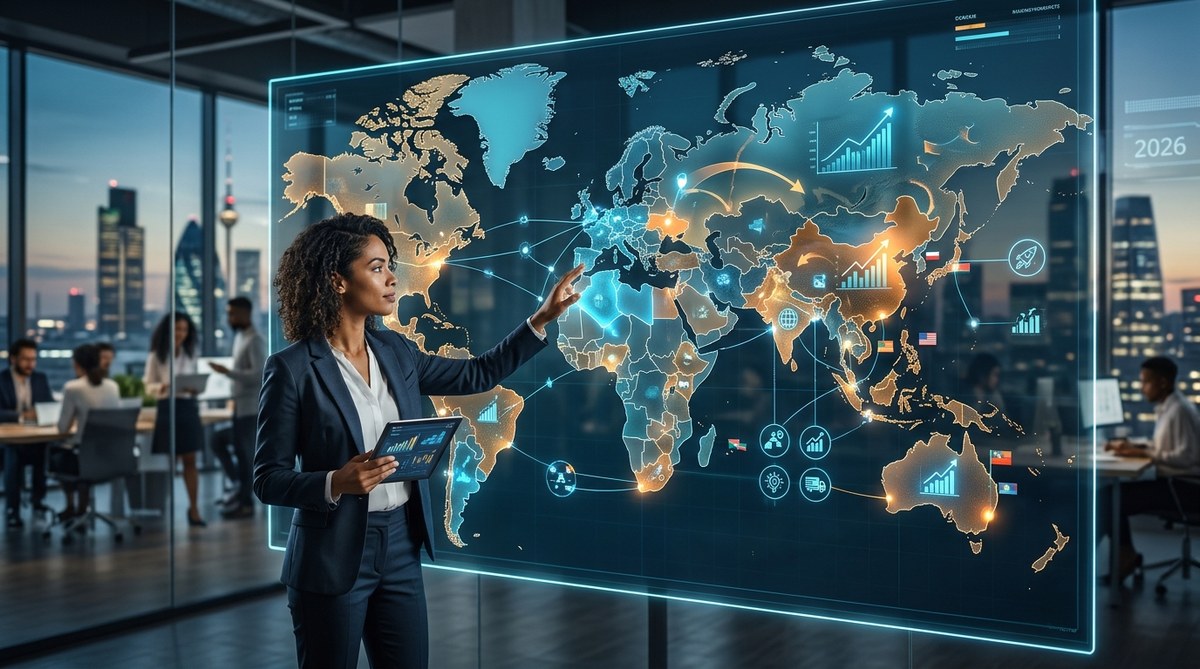
The world map is being redrawn right now. Trade corridors are shifting, alliances are reforming, and sanctions are creating new winners. For a global entrepreneur, these geopolitical shifts are not just headlines. They are signals. In 2026, the smartest founders are not reacting to change. They are reading it like a map to find untapped markets before anyone else does.
Geopolitical shifts in 2026 are creating specific, high-growth pockets of opportunity for entrepreneurs. By analyzing trade realignments, energy dependencies, and regional alliances, you can identify untapped markets before they become crowded. Success depends on reading the signals early and moving with local intelligence.
Reading the New Trade Currents
Tariffs are moving like weather patterns. The US-China trade relationship continues to reshape supply chains, but the real action is happening in secondary corridors. Vietnam, Mexico, and India are absorbing manufacturing capacity that used to sit in Shanghai and Shenzhen. This is not just about cheaper labor. It is about access.
Entrepreneurs who set up distribution hubs in Monterrey, Mexico are now serving both North American and Latin American markets from one location. The same logic applies to Eastern Europe. Founders building in Poland or Romania are positioning themselves to serve a European Union that is actively de-risking from Asian dependencies.
The key is to look for countries that are geographically close to major consumer blocs but politically neutral or aligned. These places become natural bridges.
Three Signals That Point to Untapped Markets
You do not need a CIA analyst to spot opportunity. You just need to watch three things.
-
Sanctions and export controls. When a major power blocks trade with a country, that country must find new suppliers. This creates a vacuum. Entrepreneurs who can fill that vacuum with legal, in-demand goods or services often find a captive audience with little competition.
-
Energy price divergence. Countries with access to cheap, stable energy are becoming manufacturing magnets. In 2026, the gap between energy-rich and energy-poor nations is wider than ever. Look at the Gulf states, parts of Africa with new gas finds, and the United States. If you can build a business that relies on energy inputs, move closer to the source.
-
Military spending shifts. Nations that increase defense budgets often neglect civilian infrastructure. That creates openings for private sector solutions. From logistics software to construction materials, entrepreneurs who understand the local procurement cycle can step in where government capacity falls short.
“The biggest mistake founders make is treating geopolitics as a risk to hedge against rather than a dataset to exploit. Every new barrier creates a new bypass. Find the bypass.” – Maria Kessler, founder of CrossBorder Insights
A Practical Framework for Spotting Opportunities
Let us turn those signals into action. Here is a four-step process you can apply this week.
-
Map the friction points. Identify where two major economies are pulling apart. The US and China. The EU and Russia. India and Pakistan. Then list the goods that used to flow freely between them. Those goods now need alternative routes.
-
Identify the bridge countries. Which nations are geographically or politically positioned to facilitate those alternative routes? Look for countries with improving infrastructure, stable currencies, and open investment policies.
-
Validate with local demand. A bridge country only works if its own population or businesses need what you are offering. Check import data, talk to local chambers of commerce, and look for rising consumer spending in specific categories.
-
Test with a small entry. Do not build a factory on day one. Use a partnership, a distributor, or a pop up. Validate the market with a minimal footprint before committing serious capital.
Mistakes That Cost Entrepreneurs Their Edge
Even experienced founders make predictable errors when chasing geopolitical opportunities. This table shows the most common ones and how to avoid them.
| Common Mistake | Why It Hurts | Better Approach |
|---|---|---|
| Relying on news headlines | Headlines are reactive. By the time a story is big, the market is crowded. | Use trade data and customs filings to spot trends months before the press. |
| Ignoring local politics | A country may be open for business, but local regulations or corruption can block entry. | Hire a local advisor or partner. Do not trust embassy briefings alone. |
| Assuming demand matches supply | Just because a country needs something does not mean it can pay for it. | Check currency stability and purchasing power parity before investing. |
| Moving too fast | First mover advantage is real, but being first to a failing market is worse. | Run a pilot. Use a small batch to test logistics and payment systems. |
Where the Smart Money Is Looking in 2026
Entrepreneurs who are already acting on geopolitical shifts are focusing on a few specific areas.
-
Central Asia. Kazakhstan and Uzbekistan are becoming logistics hubs as the Middle Corridor trade route expands. This connects China to Europe through the Caucasus, bypassing Russia. Warehousing, freight tech, and insurance products are all in demand.
-
The Gulf states. Saudi Arabia and the UAE are pouring money into non-oil sectors. They need everything from entertainment production to cybersecurity. The local talent pool is thin, which means foreign entrepreneurs with expertise can command premium rates.
-
Southeast Asia’s secondary cities. Ho Chi Minh City and Bangkok are well known. But cities like Da Nang in Vietnam and Cebu in the Philippines offer lower costs and growing tech talent. They are also less exposed to the trade tensions affecting larger hubs.
-
Andean region. Colombia, Peru, and Chile are stabilizing politically while offering access to both Pacific and Atlantic trade routes. Agritech, fintech, and renewable energy startups are finding receptive governments and early adopters.
For more context on how these regions are transforming the startup landscape, read about how emerging markets are transforming the startup landscape in 2026.
Building a Team That Spots Shifts Early
You cannot do this alone. The best global entrepreneurs build networks of local scouts. These are not employees. They are freelancers, former government officials, or local journalists who understand the ground truth.
A scout in Tbilisi, Georgia can tell you when a new trade agreement is actually being implemented versus just signed. A contact in Casablanca can warn you about customs delays before they hit the news. These relationships are worth more than any market report.
You can also use tools like customs data platforms and trade flow dashboards. But data without context is noise. Pair the numbers with human intelligence.
If you want to build a team that can act on this intelligence, check out how to build a global team that drives innovation across borders.
The Role of Technology in Spotting Gaps
AI and data analytics are making it easier to scan for geopolitical opportunities. Natural language processing can track policy changes in real time. Satellite imagery can show you which ports are congested and which factories are dark.
But technology is a filter, not a decision maker. The entrepreneurs who win in 2026 are the ones who combine machine speed with human judgment. They let the algorithms flag the anomalies. Then they pick up the phone and call someone on the ground.
For a deeper look at how founders are using these tools, see how global entrepreneurs are using AI to disrupt traditional industries in 2026.
A Quick Reference for Your Next Move
If you are ready to act, here is a bulleted list of questions to ask yourself before you commit to a new market.
- Is there a clear gap between local demand and local supply?
- Can I enter with a low cost pilot or do I need heavy infrastructure?
- Does the country have a stable legal system for foreign businesses?
- Are there local partners I can trust?
- What is the currency risk over the next 12 months?
- Does this market connect me to a larger region later?
Answering yes to at least four of these is a green light. Anything less means you need more information.
Turning Uncertainty Into Your Advantage
The global economy in 2026 is not stable. It is not supposed to be. Stability is a myth that keeps entrepreneurs waiting for the perfect moment. The perfect moment does not exist. What exists is a series of dislocations that create space for new businesses.
When a trade war closes one door, it opens a window somewhere else. When a country faces energy shortages, it creates demand for efficiency solutions. When a region becomes politically isolated, its neighbors become more valuable as partners.
The founders who understand this do not fear the news. They read it for clues.
If you want to see how other entrepreneurs are thinking about this moment, take a look at what successful global entrepreneurs do differently in 2026.
Spot the Shift Before the Herd Moves
Geopolitical shifts are not obstacles. They are the terrain. The best entrepreneurs learn to read that terrain and move across it with purpose. You do not need a massive budget or a team of analysts. You need curiosity, a willingness to call strangers in other countries, and the discipline to test before you invest.
Start small. Pick one trade corridor that interests you. Spend an hour this week looking at customs data for that route. Find one person who lives there and ask them what they see. That single conversation could point you toward a market that no one else has noticed yet.
The map is changing. You can watch it change, or you can start drawing your own lines on it.

Leave a Reply